
Last year, MediaTek’s Dimensity 9400 made a big impression, but it couldn’t quite match the Snapdragon 8 Elite from Qualcomm. The Dimensity 9500 from MediaTek is a daring new rival that has returned in September.
The company claims it brings massive gains in performance, power efficiency, and AI processing — all areas where Snapdragon has long dominated.
MediaTek has the best chance yet to win the performance award with the Dimensity 9500. However, is Qualcomm still the benchmark to beat, or does it finally outperform the Snapdragon 8 Elite? Let’s dive into the numbers and find out.
Let’s begin with the spec sheet.
| Dimensity 9500 | Snapdragon 8 Elite | |
|---|---|---|
| Announced | September 2024 | October 2024 |
| Process node | TSMC’s 3nm (N3P) | TSMC’s 3nm (N3E) |
| CPU cores | octa-core | octa-core |
| CPU cores | 1 x 4.21 GHz — C1-Ultra 3 x 3.5 GHz —C1-Premium 4 x 2.7 GHz — C1-Pro | 2 x 4.32GHz — Oryon (2nd gen) 6 x 3.53GHz — Oryon (2nd gen) |
| GPU | Mali-G1 Ultra MP12 120 FPS ray traced mobile gaming MediaTek HyperEngine Gaming Technology MRFC 3.0 technology | Adreno 830 Ray tacing support Snapdragon Elite Gaming features |
| NPU | MediaTek NPU 990 | Qualcomm Hexagon NPU |
| Memory | LPDDR5X, up to 5.3 GHz | LPDDR5X, up to 5.3GHz |
| Storage | 4-lane UFS 4.1 | UFS 4.0 |
| Camera | MediaTek Imagiq 1190 ISP up to 320MP single camera up to 8K video recording 4K/120fps video recording (EIS) 4K/60fps cinematic video capture real-time semantic segmentation support | Qualcomm Spectra Triple ISPs (18-bit) up to 320MP single camera up to 108MP single camera with zero shutter lag up to 48MP triple cameras with zero shutter lag up to 8K video recording limitless real-time semantic segmentation (up to 250 layers) |
| Connectivity | 3GPP Release-17 5G modem download speed: 7.4 Gbps Wi-Fi 7 (peak speed: 7.3 Gbps) Bluetooth 6.0 | Snapdragon X80 5G modem download speed: up to 10 Gbps upload speed: up to 3.5 Gbps Wi-Fi 7 (peak speed: 5.8 Gbps) Bluetooth 6.0 |
Dimensity 9500 vs Snapdragon 8 Elite: benchmark comparison
On the Geekbench 6 platform, the Dimensity 9500 achieves roughly 13% higher single-core and 9% higher multi-core scores.
The Dimensity 9500-powered phones should feel faster than the Snapdragon 8 Elite, even though these are not significant advancements.
| Geekbench 6 | Dimensity 9500 | Snapdragon 8 Elite |
|---|---|---|
| Single core | 3,452 | 3,047 |
| Multi core | 10,128 | 9,286 |
AnTuTu score
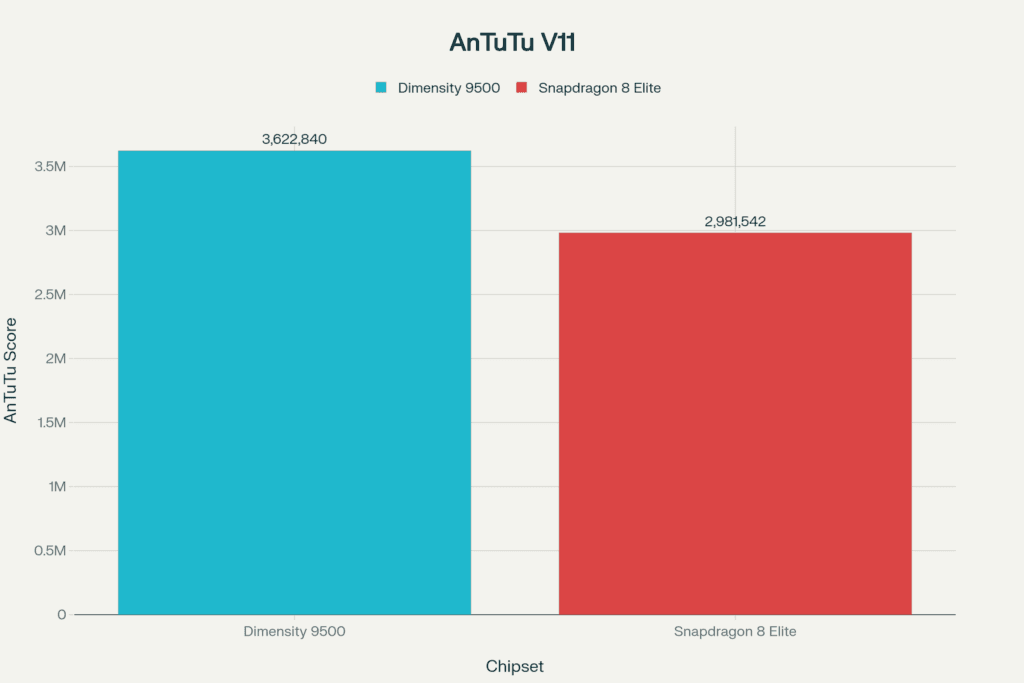
With a total score that is approximately 22% higher than that of the Snapdragon 8 Elite on AnTuTu v11, the MediaTek chip takes a clear lead.
Although the CPU scores improve by only about 5%, the GPU scores rise by more than 25%, indicating a significant improvement in graphics performance.
The Dimensity 9500 also has better memory and user experience performance, suggesting that multitasking will be easier and the app will respond faster.
| AnTuTu 11 | Dimensity 9500 | Snapdragon 8 Elite |
|---|---|---|
| AnTuTu score | 3,622,840 | 2,981,542 |
| CPU | 942,069 | 909,797 |
| GPU | 1,364,441 | 1,091,509 |
| Memory | 602,541 | 392,463 |
| UX | 713,788 | 587,773 |
3D Mark Wild Life Extreme score
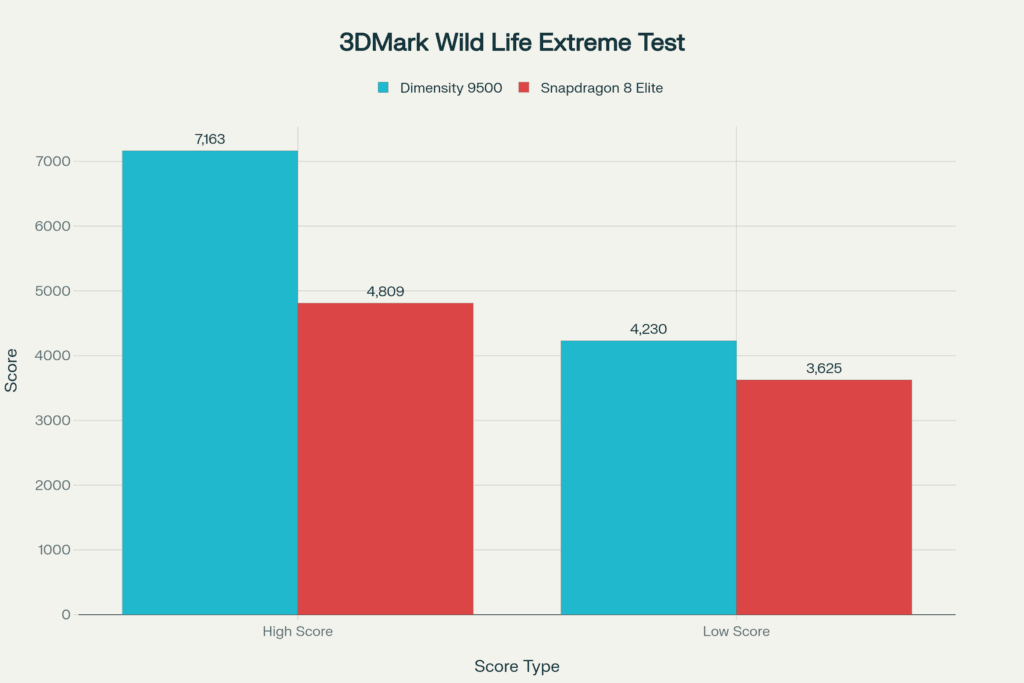
The 3D Mark Wide Life Extreme is a well-known gaming benchmark that evaluates a GPU’s performance when subjected to strenuous graphics workloads.
The best performance when the device is operating at its full potential is indicated by the high score. To put it another way, it shows how well a device can handle brief bursts of intense graphics workloads, like in demanding mobile games. .
The low score reflects how well the device maintains performance over time, showing the impact of thermal throttling and sustained workload management.
In this case, the Dimensity 9500 achieves a higher high score of 49% and a higher sustained score of 17%, indicating that it is capable of sustaining improved performance over longer gaming sessions.
| 3D Mark Extreme Test | Dimensity 9500 | Snapdragon 8 Elite |
|---|---|---|
| High score | 7,163 | 4,809 |
| Low score | 4,230 | 3,625 |
Dimensity 9500 vs Snapdragon 8 Elite: key differences
TSMC produced both chips using its 3nm process node, but they still have a few differences. The Dimensity 9500 makes use of the most recent N3P technology, which outperforms the N3E process used in the Snapdragon 8 Elite in terms of both performance and power efficiency.
The most recent ARM cores in the Dimensity 9500’s CPU are one C1-Ultra core, three C1-Premium cores, and four C1-Pro cores. In contrast.
The Snapdragon 8 Elite makes use of custom-designed Oryon CPU cores from the second generation. In fact, this is Qualcomm’s first mobile chipset with Oryon cores.
The Dimensity 9500 has a 12-core Mali-G1 Ultra GPU that can handle graphics-related tasks like gaming and visual rendering. It also supports 120 frames per second ray-traced mobile gaming.
In addition, the chip is equipped with MediaTek HyperEngine Gaming Technology, a set of gaming features aimed at minimizing power consumption while simultaneously enhancing gaming performance.
The new sliced architecture Adreno 830 GPU is included in the Snapdragon 8 Elite. For a better gaming experience, it also supports hardware-based ray tracing and the Snapdragon Elite Gaming features.
Due to the MediaTek NPU 990 on the Dimensity 9500 and a Qualcomm Hexagon NPU on the Snapdragon 8 Elite, the two chipsets also do not miss out on the on-device AI capabilities.
With large context windows and agentic AI capabilities, both are extremely efficient and high-performance NPUs. The NPUs also help optimize camera performance, connectivity, and gaming.
The Dimensity 9500 has the Imagiq 1190 ISP, which can record up to 8K video and support up to 320MP for a single camera.
The chip, according to MediaTek, can record 4K/60fps cinematic video and 4K/120fps videos with electronic image stabilization (EIS). The chip also supports real-time semantic segmentation.
The Snapdragon 8 Elite also features power camera capabilities, enabling up to 320MP single-camera capture and up to 8K video recording. At 4K resolution, it has 18-bit triple ISPs with unlimited semantic segmentation.
The chip also provides a number of camera features, such as Truepic photo capture, Video super resolution, AI-based auto-exposure, AI-based auto-focus, and AI-based face detection.
The connectivity between the two flagship chipsets also differs significantly. A 3GPP Release-17 5G modem in the Dimensity 9500 enables a maximum speed of up to 7.4 Gbps.
It can reach speeds of up to 7.3 Gbps over a Wi-Fi 7 connection. On the other hand, the X80 5G modem in the Snapdragon 8 Elite is capable of uploading and downloading data at speeds of up to 3.5 Gbps and 10 Gbps, respectively.
Over a Wi-Fi 7 connection, the maximum speed is 5.8 Gbps. In short, MediaTek leads in Wi-Fi throughput, while Qualcomm maintains an edge in 5G performance.
For more daily updates, please visit our News Section.