
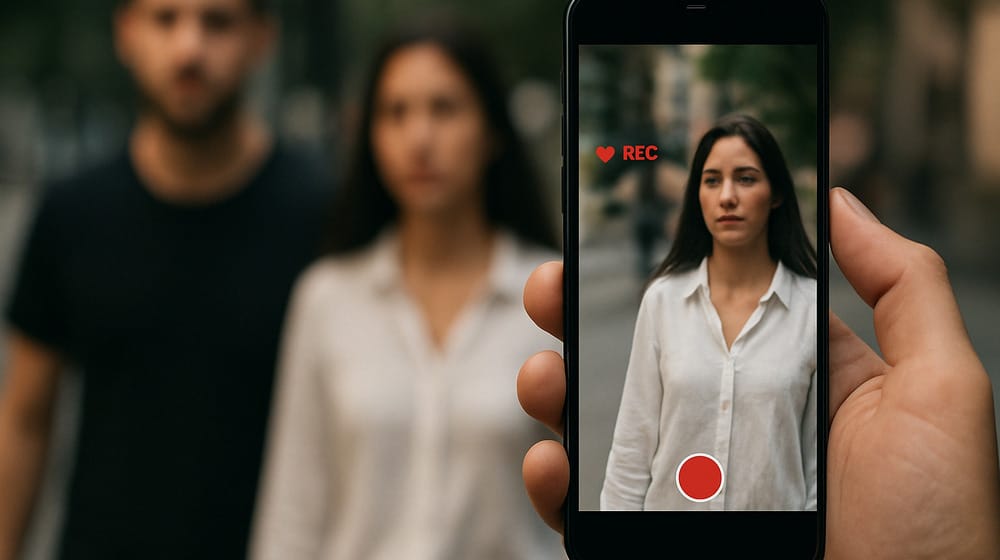
The Punjab government has made public a contentious revision to the Punjab Safe Cities Authority (PSCA) app for public safety that enables the cameras of nearby citizens to act as surveillance tools. The app is highly lacking in privacy protection measures.
Here is why it can easily turn into a privacy nightmare.
New Camera Feature
Following the recent “PSCA – Public Safety App” upgrade, people are enabled to share live footage of the scene via their smartphone cameras right to the Safe City control room without any delay.
In the event of a call to the emergency helpline 15, the user is provided with a unique link for a live feed. When accessed, this link automatically connects the camera on their phone to the police, allowing them to view the latest video recordings.
PSCA officials say that the characteristic will give the capacity to confirm the events more swiftly and to send the help to the place of the incident faster, hence, it is a tool that can save lives.
Why It’s a Privacy Nightmare
We definitely should not forget that this characteristic might be converted into a weapon for the monitoring of the entire population, the maltreatment, and infringement of privacy.
In a nation where videos from permanent traffic and enforcement cameras have been leaked or shared online already, the provision of a “mobile Safe City camera” to just about anyone escalates the possibility of the misuse of the power to a great extent.
The Safe City program is already heavily reliant on the use of various city-wide cameras, number-plate recognition, as well as, in the near future, facial recognition.

If there are no well-defined laws that regulate the access, storage, and sharing of the footage, then the mere broadcasting of the video adds another dimension of risk: the collection of data of an entirely private nature without any control and the subsequent use of such data in a manner that the person concerned is not authorized to.
How It Could Go Wrong
Turning citizens’ phones into surveillance tools can have many dangers, including:
- Under the false guise of “reporting,” people may film others random without any consideration, thereby making public life a never-ending observation.
- During crises, live streams might depict the most horrific situations, but these are only a few of the possible scenarios of how these videos would be handled. They could be recorded, shared, or sold just as easily. In the absence of data retention boundaries or supervision, videos might find their way to the internet or the possession of ill-intentioned individuals.
- The use of mobile cameras in this manner, along with the current setup that is already connected to license plate and facial recognition, can result in a scary situation where innocent people get watched by the authorities. The so-called safeguarding of public safety could actually become an indefinite extension of mass surveillance.
Strict Guardrails Required
A live stream of what is happening can really be of great help in an emergency. These situations might be crimes, accidents, medical emergencies, or any cases where the responders can be helped to act quickly by a visual. And actually, this is a correct application of the technology.
Just to mention, the PSCA conveys that the capability is an extremely last resort kind of thing, which means it is not intended for sharing videos just for fun.
But the danger lies not in the tool itself, but in the lack of clear boundaries, oversight, and accountability. Without transparent rules on footage access, sharing, storage, and deletion, and without legal protections for citizen privacy, the risks may easily outweigh the benefits.
How to Avoid Privacy Issues
Required safeguards should include:
- Strict limits on when live streams are accepted (only genuine emergencies).
- Short, legally mandated retention periods for any footage.
- Transparent records of who accessed what footage and when.
- Strong penalties for misuse, leaks, or sharing without consent.
- Independent oversight to audit how often and why footage is used.
Alternatively, what is presented as an enhancement for public safety may swiftly transform into a widespread, unmonitored surveillance system, converting every individual’s phone into a device for observation, rather than for safeguarding.
For more daily updates, please visit our News Section.